Active MVP onboarding
Joined an evolving MVP with product direction already in place and another UI/UX designer leading the broader experience.

CASE STUDY — 01
Contributed to an evolving industrial ERP MVP focused on weld tracking, blueprint visibility, operational approvals, and workflow refinement. Worked closely across UX, implementation, and testing to improve usability inside active production constraints.
Industry
Industrial Infrastructure
Role
UI/UX Engineer
Timeline
3 Months

01 — Joining an active MVP
I joined after the MVP prototype was already moving. Product direction was in place, another UI/UX designer was leading the broader experience, and weld-management modules were being implemented progressively.
The MVP scope centered on operational weld workflows: tracking, import/export handling, approvals, notes, progress visibility, and blueprint pin mapping.
Active MVP onboarding
Joined an evolving MVP with product direction already in place and another UI/UX designer leading the broader experience.
Weld workflow scope
Focused on weld tracking, blueprint pin mapping, approvals, notes, progress visibility, and import/export handling.
Workflow validation
Tested operational flows, documented friction, and refined interactions around real MVP behavior.
02 — Auditing the experience
I moved through the MVP with fresh eyes: testing flows, capturing screenshots, and turning workflow friction into implementation notes the team could act on.
Workflow friction mapping
Repeated record switching slowed operational tasks.
MVP usability audit
Captured workflow friction through testing and implementation notes.
Interaction consistency
Aligned inconsistent action behavior across operational flows.
03 — Building design consistency
The design-system work stayed practical: organize repeated assets, make interaction patterns easier to reuse, and support new weld workflow screens as the MVP expanded.
Reusable components
Organized repeated interface elements into clearer reusable patterns without treating the MVP as a full redesign.
Design variables
Helped establish consistent variables and asset organization for workflows that were still changing.
Progressive structure
Improved maintainability so new weld workflow screens could build from clearer foundations.
04 — Solving bulk workflows
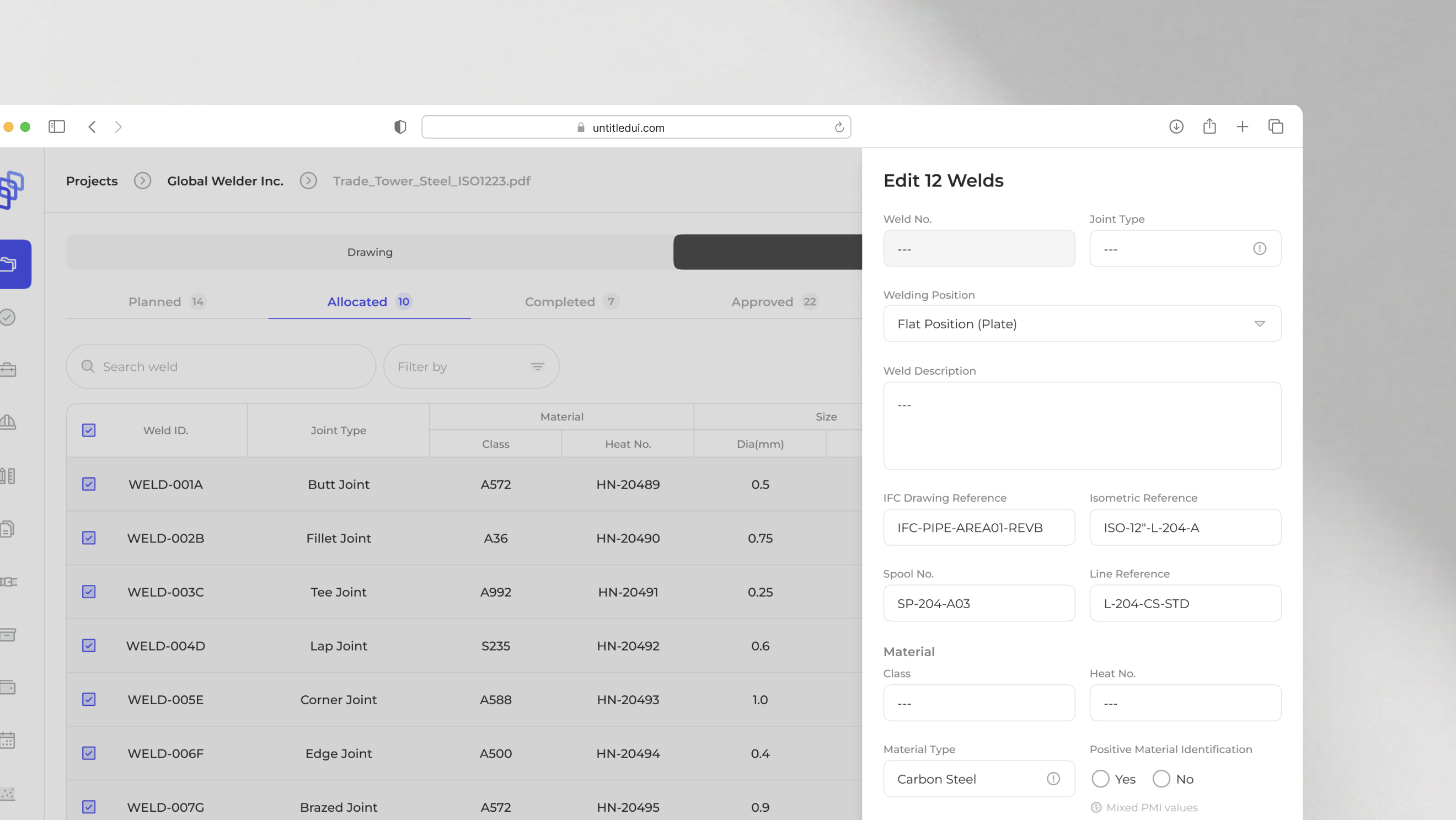
As the MVP expanded, edit, delete, and allocation actions exposed a workflow limitation: key operational actions were buried inside individual records. The refinement moved frequent actions closer to the list workflow without changing how users understood the system.
Bulk multi-selection workflow
Introduced multi-select behavior so users could act on several weld records without opening each one individually.
Contextual action visibility
Made edit, delete, and allocation actions appear when they were relevant to the selected records.
Reduced repetitive navigation
Moved repeated actions closer to the list workflow, reducing back-and-forth record navigation.
Product thinking
The challenge wasn’t adding bulk actions. It was introducing them without disrupting existing operational habits.
The interaction had to feel like a natural extension of the current workflow: visible when needed, quiet when irrelevant, and precise enough for weld records, allocation logic, and approval-sensitive operational data.
05 — Designing around limitations
Bulk editing raised harder questions around mixed field values, multi-select constraints, accidental changes, and what the interface should protect during implementation.
Constraint
Mixed data state handling
Explored how bulk editing should behave when selected weld records contained different field values.
UX decision
Multi-edit interaction logic
Defined what users should see, change, or leave untouched when editing multiple records at once.
Product impact
Operational clarity
Protected users from assuming every selected weld record shared the same editable values.
Constraint
Use case documentation
Documented scenarios and edge cases so PMs and developers could evaluate behavior before implementation.
UX decision
Workflow iteration exploration
Created iterations around selection states, action placement, field behavior, and review points.
Product impact
Operational clarity
Made edge cases concrete enough for PM and developer review before implementation.
Constraint
Enterprise pattern validation
Validated the direction against common enterprise patterns for bulk actions and data-heavy workflows.
UX decision
Cross-functional collaboration
Reviewed flows with PMs and developers to balance usability, data limitations, testing feedback, and implementation effort.
Product impact
Operational clarity
Kept the workflow aligned with familiar enterprise bulk-action behavior and real MVP limits.
06 — Reflection
This project reinforced that operational UX inside an enterprise MVP is rarely about starting from a blank page. The work is often to understand what is already being built, then refine the workflows that carry the most operational weight.
The most useful decisions came from auditing the weld-management experience, validating behavior during implementation and testing, and improving repeated workflows without asking users to relearn the product.
